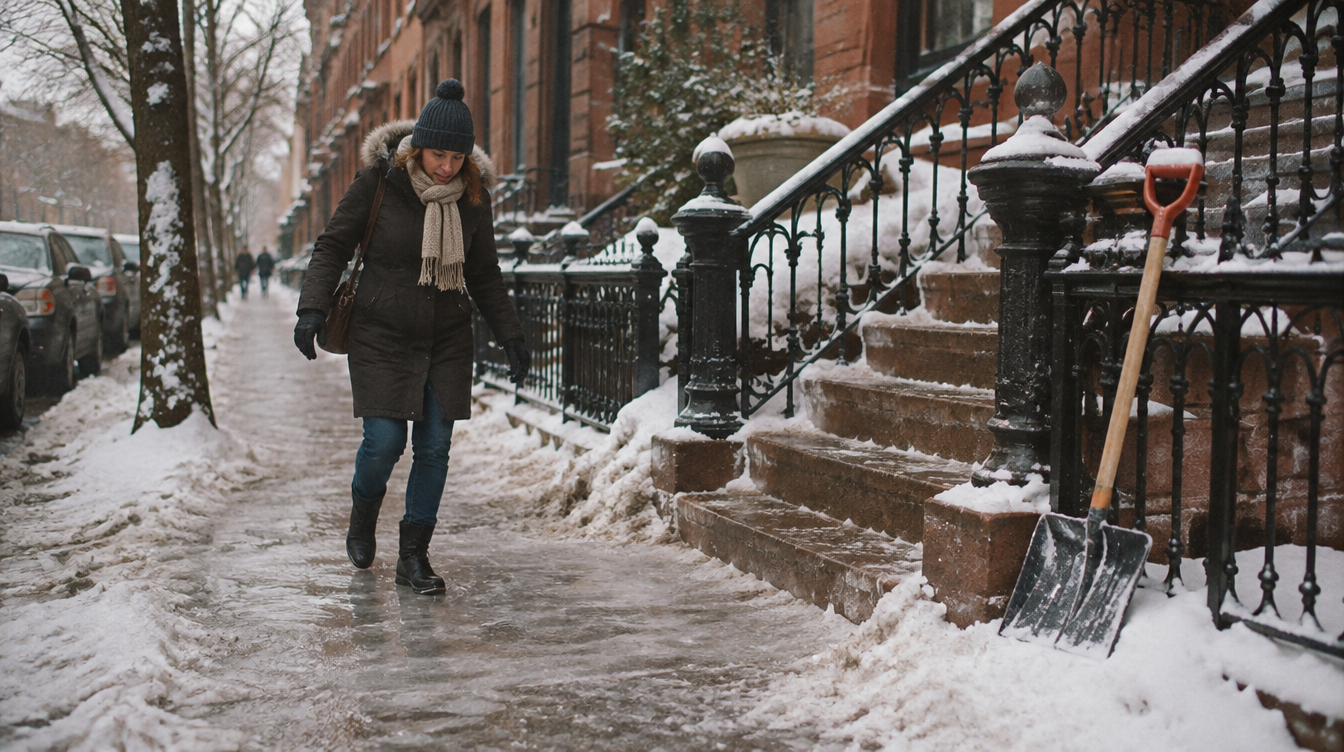
If you slip on snow or ice on a New York City sidewalk, the person responsible is usually the owner of the building next to the sidewalk, not the City. Under NYC Administrative Code §7-210, most property owners must keep the sidewalk in front of their buildings reasonably safe, and that includes clearing snow and ice.
There are important exceptions, and there are timing rules that decide whether an owner had a duty to act yet. Here is how winter fall claims work in NYC, who can be held responsible, and what evidence matters most.
Key Takeaways
- Under Administrative Code §7-210, owners of most commercial and larger residential buildings are liable for unsafe abutting sidewalks, including snow and ice.
- The City generally remains responsible for sidewalks next to one-, two-, and three-family homes that are owner-occupied and used only as residences.
- Administrative Code §16-123 requires owners to clear snow and ice within four hours after snow stops falling, not counting 9 p.m. to 7 a.m.
- Under the “storm in progress” rule, an owner usually has no duty to clear the sidewalk until a reasonable time after the storm ends.
- Claims against the City require a notice of claim within 90 days (General Municipal Law §50-e).
Who is responsible for snow and ice on a NYC sidewalk?
Before 2003, the City was responsible for most sidewalk falls. Administrative Code §7-210 shifted that duty to the owners of the property next to the sidewalk. Today, if you fall on an icy sidewalk in front of a store, office building, or apartment building, the building owner is usually the right defendant.
Depending on the lease, a commercial tenant or a snow removal contractor may share responsibility. Identifying every responsible party early matters, because each one may point to the others.
When is the City still responsible?
Section 7-210 does not apply to one-, two-, or three-family residential properties that are at least partly owner-occupied and used only for residential purposes. For those sidewalks, the claim is generally against the City of New York.
Claims against the City come with strict rules. You must file a notice of claim within 90 days, and the City often argues it had no prior written notice of the condition. We explain those deadlines in our post on suing New York City after an accident.
How long does an owner have to clear the snow?
Administrative Code §16-123 requires owners to remove snow and ice, or spread sand or salt where ice cannot be removed, within four hours after the snow stops falling. Snow that stops between 9 p.m. and 7 a.m. does not count toward the four hours until 7 a.m.
Courts also apply the storm in progress rule. An owner generally is not liable for a fall that happens while snow or freezing rain is still falling, or before a reasonable time has passed after it stops. The rule has limits: if an owner’s cleanup made the condition worse, or if the ice was left over from an earlier storm, the owner can still be responsible.
What about black ice and refrozen melt?
Some of the most dangerous falls happen days after a storm, when snow piles melt during the day and refreeze overnight. Owners often argue that black ice was invisible and formed too recently to be fixed. The response is evidence: weather records showing temperatures, photos of snow piles left uphill of the ice, and proof that the owner never salted. A pattern of the same hazard forming in the same spot can also show the owner should have known.
Proving what the owner knew is the core of most premises cases. We break that down in proving the owner knew about the hazard.
What should you do after a fall on ice?
- Photograph the spot right away, including the ice, nearby snow piles, and the building address. Ice melts, and the evidence disappears.
- Note the time and weather, including when the last snow fell.
- Get names of witnesses and of any employee or superintendent who saw the fall.
- Keep your shoes and clothing as they were.
- Get medical care the same day. Wrist fractures, hip fractures, and head injuries are common in ice falls and can worsen without treatment.
Even if the owner claims you should have been more careful, New York’s comparative negligence rule may reduce your recovery but does not bar it.
Hurt in a Fall on Snow or Ice in NYC?
Winter fall cases turn on details that disappear with the next thaw. The NYC slip and fall lawyers at Keith D. Silverstein & Associates have recovered millions for injured New Yorkers and know how to identify the right owner and preserve the proof. Call 212-385-1444 for a free consultation.
Keith D. Silverstein · Admitted to the New York Bar, 1987 · Read Keith’s bio
This article is general information about New York law, not legal advice, and does not create an attorney-client relationship. Every case is different. Attorney Advertising.