If a car hits you while you are riding a bicycle in New York City, you are generally entitled to no-fault benefits for your medical bills and lost wages, even though a bicycle is not a motor vehicle. For no-fault purposes, a cyclist struck by a car is treated much like a pedestrian, and the benefits usually come from the car’s insurer or from an auto policy in your own household.
That coverage helps right away, but it also means the serious injury threshold generally applies if you want to sue the driver for pain and suffering. Here is how bike crash claims work in NYC, from dooring to bike lane collisions.
Key Takeaways
- A cyclist hit by a motor vehicle is generally eligible for New York no-fault benefits of up to $50,000, regardless of fault.
- Because the cyclist is covered by no-fault, a lawsuit for pain and suffering generally requires a “serious injury” under Insurance Law §5102(d).
- Opening a car door into traffic when it is unsafe violates Vehicle and Traffic Law §1214, which makes “dooring” cases strong on liability.
- Helmets are required for riders under 14 (VTL §1238). An adult without a helmet can still recover.
- File your no-fault application within 30 days, and sue within three years in most cases (CPLR §214(5)).
Does no-fault cover cyclists in New York?
Yes, when a motor vehicle is involved. If you or a relative you live with owns an insured car, that policy usually pays first. If not, the insurer of the vehicle that hit you generally pays. If the driver fled or had no insurance, MVAIC may be available. We cover that path in our post on uninsured and hit-and-run drivers.
A crash between two bicycles, or a fall caused by a pothole, does not trigger no-fault. Those cases are handled as ordinary negligence claims against the rider, property owner, or the City.
What is a dooring accident, and who is liable?
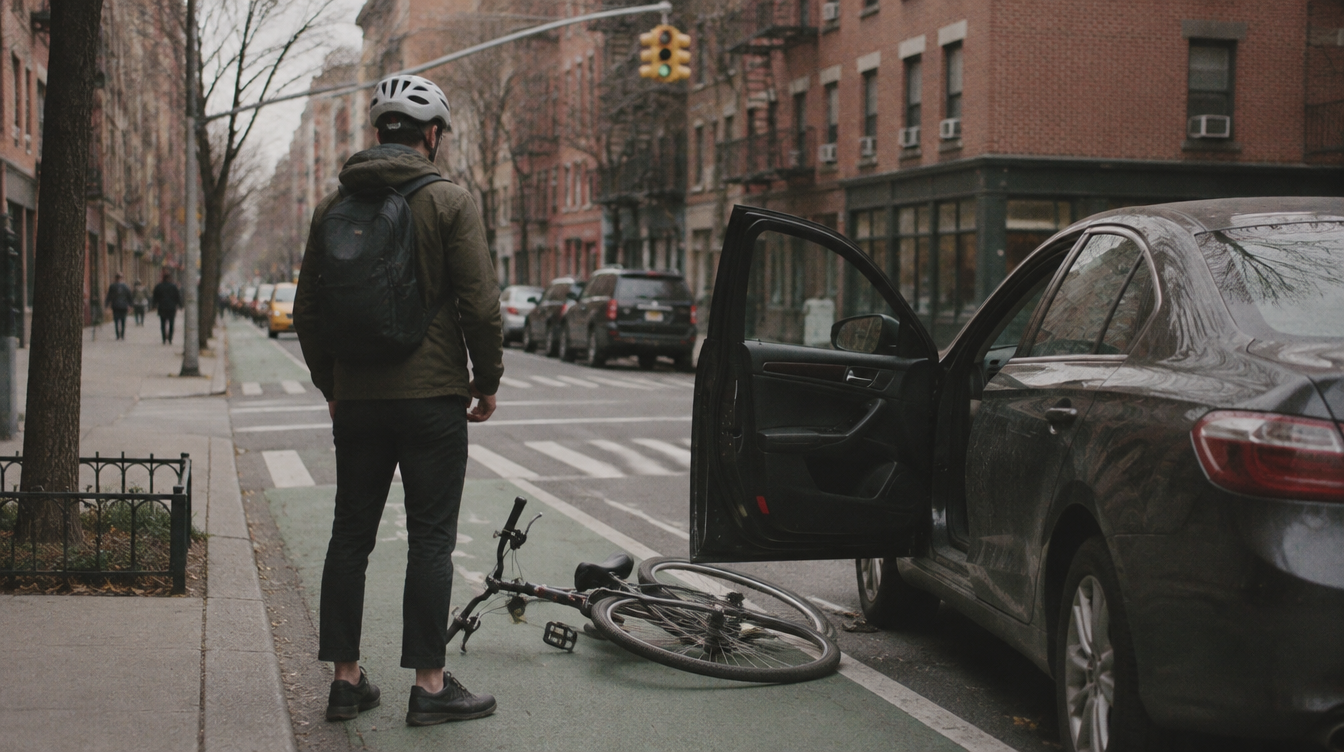
Dooring happens when a driver or passenger opens a car door into the path of an oncoming cyclist. Vehicle and Traffic Law §1214 prohibits opening a door on the traffic side unless it is reasonably safe and does not interfere with traffic. A violation of that statute is strong evidence of negligence.
Dooring claims can involve the driver, the passenger who opened the door, and, for taxis and rideshares, the commercial insurer. Our Uber and Lyft insurance post explains how those policies apply.
What if the driver says you weren’t in the bike lane?
Under VTL §1234, cyclists must use a bike lane where one is provided, but the law allows you to leave it to avoid hazards, make turns, or pass. Drivers, delivery trucks, and parked cars that block bike lanes often force cyclists into traffic.
Even if you were partly outside the lane, New York’s comparative negligence rule only reduces your recovery by your share of fault. It does not bar the claim.
Do I need a “serious injury” to sue?
In most car-versus-bike cases, yes. Because you are eligible for no-fault, you can sue the driver for pain and suffering only if your injury meets one of the categories in Insurance Law §5102(d), such as a fracture, a permanent limitation, or a disability lasting 90 of the first 180 days. Cyclists often suffer wrist, collarbone, and facial fractures, which generally satisfy the threshold.
We explain the threshold in detail in New York no-fault and when you can sue.
What should you do after a bike crash?
- Call 911 and make sure a police report lists the driver and the vehicle.
- Photograph your bike, the car, the door or bumper that hit you, and the lane markings.
- Keep the bike and helmet unrepaired. They show the force and direction of impact.
- Look for cameras. Storefronts, buses, and doorbells often record the crash, but footage is overwritten fast.
- See a doctor the same day, and file your no-fault application within 30 days.
Hit While Riding a Bike in NYC?
Drivers and insurers often blame cyclists first. The NYC bicycle accident lawyers at Keith D. Silverstein & Associates have recovered millions for injured New Yorkers and know how to prove what the driver did wrong. Call 212-385-1444 for a free consultation.
Keith D. Silverstein · Admitted to the New York Bar, 1987 · Read Keith’s bio
This article is general information about New York law, not legal advice, and does not create an attorney-client relationship. Every case is different. Attorney Advertising.