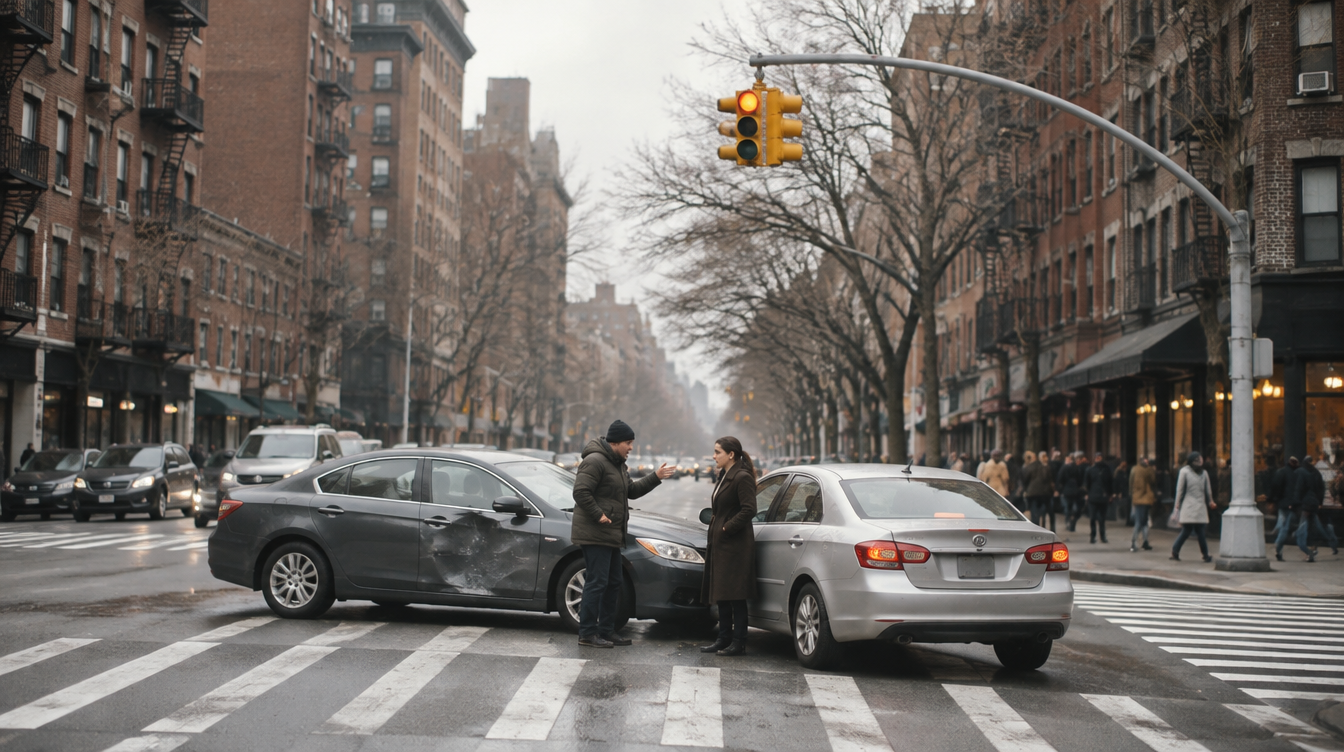
Being partly at fault for an accident does not stop you from recovering in New York. Under CPLR §1411, New York follows pure comparative negligence: your compensation is reduced by your share of the blame, but it is not wiped out, even if you were mostly at fault.
Insurance companies know most people assume the opposite. Getting you to believe “it was partly my fault, so I have no case” is one of the cheapest ways to close a claim. Here is how the rule works, how fault gets divided, and why the percentage matters so much.
Key Takeaways
- New York is a pure comparative negligence state (CPLR §1411). You can recover even if you were more at fault than the other side.
- Your award is reduced by your percentage of fault. If you were 20% at fault, you recover 80% of your damages.
- Not wearing a seatbelt can reduce damages for injuries the belt would have prevented, but it does not decide who caused the crash (VTL §1229-c(8)).
- Under CPLR §1601, a defendant 50% or less at fault may owe only its share of non-economic damages, but CPLR §1602 makes exceptions, including most motor vehicle cases.
- In scaffold and ladder falls under Labor Law §240(1), a worker’s own carelessness is generally not a defense at all.
How does pure comparative negligence work?
A jury, or the parties in settlement talks, assigns each person a percentage of fault. Your total damages are then reduced by your share. For example:
- Total damages: $500,000
- Your share of fault: 30%
- Your recovery: $350,000
Many states bar recovery once a plaintiff is 50% or 51% at fault. New York does not. A pedestrian who crossed against the light, or a driver who was speeding slightly, can still recover from a driver who was more careless.
How is fault divided in a New York accident?
Fault is decided from evidence, not from who apologized at the scene. The most important proof usually includes:
- Traffic and surveillance video, which is often overwritten within days
- Vehicle damage patterns and black-box data
- Police reports and witness statements
- Violations of the Vehicle and Traffic Law, such as failing to yield or following too closely
- Your own statements to insurers and on social media
That last item matters. Adjusters routinely use recorded statements and posts to push your percentage higher. We explain the risk in how social media can hurt your NYC injury case.
Does not wearing a seatbelt hurt your case?
It can reduce the damages, but not the way insurers often suggest. Under Vehicle and Traffic Law §1229-c(8), failure to wear a seatbelt can be used only to reduce damages for injuries the belt would have prevented. It cannot be used to argue you caused the crash. The defense must prove the belt would have made a difference, usually with expert testimony.
What happens when there are several defendants?
Under CPLR §1601, a defendant found 50% or less at fault is generally responsible only for its share of non-economic damages such as pain and suffering. That can matter if the most-at-fault party has little insurance.
The rule has important exceptions in CPLR §1602. Among them, it generally does not limit liability arising from the use or operation of a motor vehicle, and it does not apply to certain construction-site claims under the Labor Law. In those cases, each liable defendant can be responsible for the full judgment.
When doesn’t your own fault matter at all?
In gravity-related construction accidents, New York’s Scaffold Law imposes absolute liability on owners and contractors who fail to provide proper safety devices. A worker’s comparative negligence is generally not a defense to a Labor Law §240(1) claim. We cover this in how Labor Law 240 protects construction workers.
Fault allocations are also a negotiation tactic. Adjusters often open with an inflated percentage to lower the offer. We break down that approach in how the insurance defense playbook works.
Told You Were Partly at Fault?
An insurer’s fault percentage is an opening position, not a final answer. The NYC personal injury lawyers at Keith D. Silverstein & Associates have recovered millions for injured New Yorkers and know how to challenge an unfair allocation of blame. Call 212-385-1444 for a free consultation.
Keith D. Silverstein · Admitted to the New York Bar, 1987 · Read Keith’s bio
Published November 4, 2026 · Last reviewed November 2026
This article is general information about New York law, not legal advice, and does not create an attorney-client relationship. Every case is different. Attorney Advertising.


