
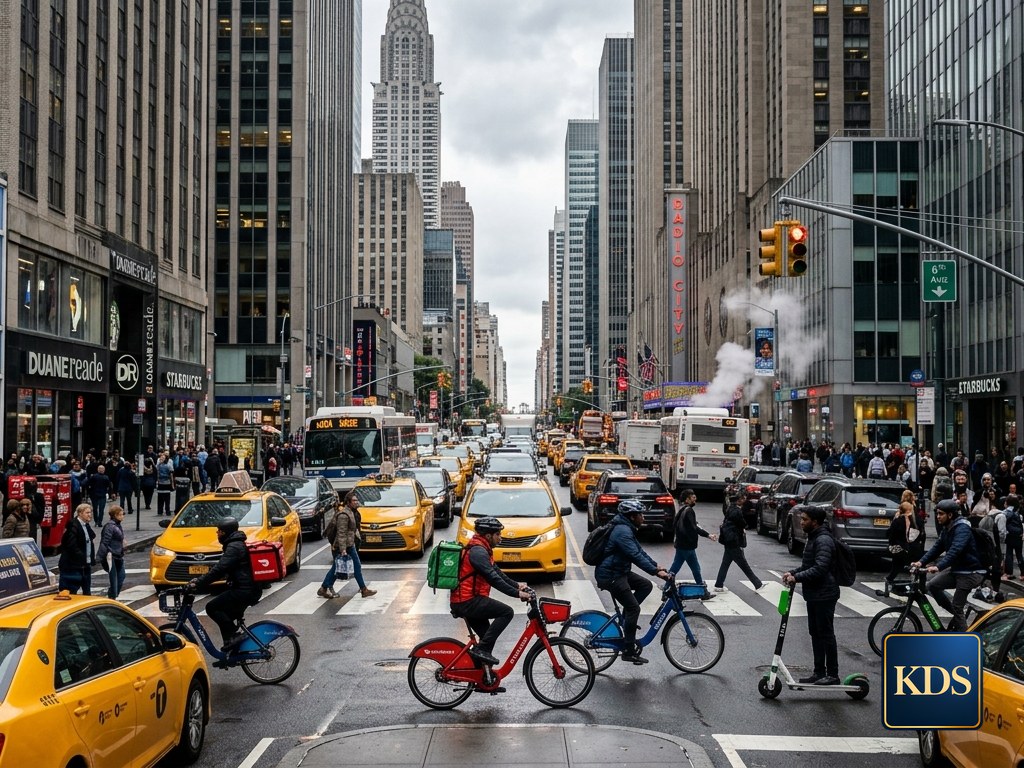
Electric bikes and scooters are everywhere in New York City. Delivery riders on Radpower bikes dart between cabs. Tourists grab Citi Bike e-assists for a cruise through Central Park. Commuters blast down Fifth Avenue on personal e-scooters hitting 20 miles per hour.
And when they crash into a pedestrian, a cyclist, or another vehicle, one question takes over: who pays?
The answer is not simple. And if you do not move quickly, you could lose the evidence you need to find out.
Why E-Bike and E-Scooter Accidents Are Different
Traditional car accident cases follow a familiar path — you identify the driver, exchange insurance, and file a claim. E-bike and e-scooter accidents do not work that way.
Here is what makes them complicated:
Delivery riders often work for multiple apps simultaneously. The Grubhub logo on the bag does not mean Grubhub is the employer — or that they accept liability.
E-scooter rental companies write their user agreements to limit liability aggressively. Those waivers are not always enforceable.
Personal e-bike and e-scooter owners often carry no dedicated insurance — but their homeowner’s or renter’s policy may still apply.
In commercial delivery cases, the platform, the merchant, and the logistics company can all be named as defendants.
Getting this wrong means leaving money — and justice — on the table.
New York Law and E-Bikes: What You Need to Know
New York has gone through significant changes in how it classifies electric bikes and scooters. Class 1, 2, and 3 e-bikes are now legal on NYC streets, with speed limits and lane requirements. E-scooters are permitted in designated zones.
That legality does not reduce liability. If anything, it clarifies it: when an e-bike or e-scooter rider violates traffic laws — running a red light, riding on the sidewalk, traveling too fast — their liability increases.
Comparative negligence also applies. If you were jaywalking or stepping into a protected bike lane, the defense will try to use that against you. Do not let them. New York’s comparative fault rules allow you to recover even if you were partially at fault.
The Insurance Battle After a Delivery Accident
When a DoorDash, Uber Eats, or Amazon delivery rider hits you, the liability picture gets deliberately complicated.
Major delivery platforms classify riders as independent contractors. This is not just a labor issue — it is a liability shield. If the rider is not an “employee,” the platform argues they are not responsible for the rider’s actions.
But courts look at more than a job title. They look at:
Whether the platform controlled the rider’s route and schedule.
Whether the rider was actively on a delivery at the time of the accident.
Whether the platform required the vehicle the rider used.
Whether the platform provided insurance coverage at the time of the incident.
Amazon Logistics, for example, carries commercial liability insurance for delivery service partners — but the coverage depends heavily on the specific circumstances of the accident. These fights happen at the insurance level first, and they happen fast.
What to Do After an E-Bike or E-Scooter Accident
The steps you take in the first 24 to 48 hours matter.
Call 911. Get a police report. Even if the rider claims it was minor, you need documentation.
Photograph everything. The vehicle, identifying markings, your injuries, the road conditions, any skid marks or debris.
Get the rider’s information. Name, phone number, and if it is a commercial delivery, the name of the platform and the order they were fulfilling.
Report to the platform. If this was an Uber Eats, DoorDash, or Amazon delivery, report the incident directly to the platform to create a record.
Seek medical care immediately. Even if you feel fine, get evaluated. Adrenaline masks pain. A gap in medical treatment will be used against you.
Contact an attorney before you speak to any insurance company.
Keith D. Silverstein & Associates: We Know How Platforms Fight These Cases
Before founding KDS Law, Keith Silverstein spent 25 years representing insurance companies. He knows every argument they use in delivery and e-bike accident cases — and he knows how to take them apart.
If you were hit by a delivery rider or e-scooter operator in New York City, you deserve someone who has been on the other side of the table. Someone who does not guess at the defense strategy — someone who knows it.
Call Keith D. Silverstein & Associates today. Free consultation. No fees unless we win.